Backstage with Tracy Stock, CSP

I was recently interviewed and featured in a monthly newsletter by Picture Perfect Speaker—a speaker bureau who hires me to inspire audiences—in addition to business I secure myself directly with clients. The article published in the newsletter was entitled, “Backstage with Tracy Stock, CSP.” Here are my answers to some of the questions which provide insight as to why I became a professional speaker as well as significant moments in my life that have greatly influenced my thoughts and actions along the way.

What was your inspiration for becoming a professional speaker? In college I was a Communications Major. One of my professors, CY Allen, taught one of the most loathed classes by most—public speaking. Interestingly, I found myself energized by the art, in awe by his expertise, and I constantly aspired to become better. He definitely challenged me and taught me the importance of preparation and practice…over and over and over. It was by far my most loved class of my college education. I eventually applied that speaking skill as a training professional, then as a Director of Learning & Development, and ultimately paved the path for me to start my own speaking business—which includes both keynote speaking and live/virtual training.

What played a critical role in motivating you to become a professional speaker? In my late twenties, I was focused on climbing the corporate ladder. I had received three promotions already, but wanted more. I couldn’t get from point A to point B fast enough. Life was all about how to become even more successful. Then after enduring some intense traveling pain in my joints, I was eventually diagnosed with Systemic Lupus. My doctor said, “Make changes in your life, or Lupus will make them for you.” After struggling intensely for two years to slow down, my body continued to weaken and I became thin, frail and easily fatigued. Work consumed my energy and what little remained went to my family. I had nothing left for myself. My life was deteriorating before her eyes. I was now facing my fork in the road.

When I heard I had Lupus, I had a choice to make. One option was to wallow in denial, look for pity, think and act as a victim, and make little-to-no changes in my life. After two grueling years, I chose another option. I followed The One Choice Rule and chose to look at this disease as a gift. Had I not become ill with Lupus, I likely never would have slowed down to have my youngest son. Had I not been diagnosed with this disease, I would have never understood how wonderful and meaningful a family’s love and support could be. Had I not been given the unwelcomed news of this ailment, I would have never learned to enjoy the art of landscaping, which happens to be one of my favorite hobbies today. Had I not been detected with this disorder, I wouldn’t know how to relax, whether on a sandy beach or my living room couch. Had I not struggled to hear I had Lupus, I would never have felt compelled to share this story, or become a speaker and author with a desire to help others avoid a similar struggle, or inspire others with feelings of lasting hope and optimism, unwavering strength and resilience, and heartfelt support and love. This one choice I made…changed everything.

What genuinely motivates you? My motivation comes from a positive mindset and attitude, a happy disposition, and an intense desire to live my best life—which includes doing everything I can to positively influence the lives of others.

What makes you unique? In addition to priding myself on being a fun and highly engaging speaker, I integrate interactive activities into every keynote. After sharing a specific key point, I challenge the audience to do something that provides a significant and applicable ah-ha and also allows for easy application professionally or personally. Additionally, if allowed, I enjoy interacting with the audience by asking questions and encouraging interactivity. I provide participation coins in exchange for inspirational and fun prizes they can choose from.

What advice would you give the younger version of yourself if you could? Always remember that the audience is there for your message, not you; so relax, be vulnerable and deliver your message in a way where you truly connect with as many individuals in the audience as possible.

What is one impact you want your life to have? For my two sons to feel as if I guided their lives in meaningful and influential ways and taught them the importance of love and happiness in every aspect of their life.

What habits have you developed that have helped you become a better version of yourself?

  • Treat your mind and body with the respect and care it deserves so you can continue to do what you love and live your best life—meaning, get enough quality sleep, eat a nutritious and balanced diet and exercise on a regular basis (six days per week! 😊).
  • Prepare. Prepare. Prepare. Preparation calms nerves, enhances confidence and helps you nail delivering your message as desired.
  • Turn hardships I endure into learning opportunities and then integrate that story into a message.

What are the biggest challenges you face as a speaker? Balancing travel to avoid feeling exhausted.

What was one of the most challenging times, and what pulled you through it? At the height of COVID in March of 2020, my business came to a sudden halt, as it did for most speakers. In the middle of a divorce living in Colorado and now having no income for the unforeseen future, I felt paralyzed and scared. I made the decision to take control of what I had control of and set the uncontrollable aspects aside. In under 30 days, I purchased a new home, moved across country to North Carolina—hiring an essential moving company to transport my belongs and vehicle—and used my newfound “available” time to rebrand my business with a new name, a new business identity, and a new website with all new marketing materials. I learned everything I could about the virtual speaking craft and decided to master this new art, while using video footage to create a virtual demo reel in addition to launching a new live speaking reel.

What pulled me through this difficult time was a statement I share with audiences frequently, which is, “We all face tough stuff. It’s never the tough stuff, though, that does you in; rather, it’s your reaction to the tough stuff.” Then I also remembered a life lesson from my late Mother who was vibrant, positive and extremely resilient who would say, “You can only cry for so long.” I allowed myself 24 hours to cry and feel helpless, and then I decided to formulate a plan and execute it.

What is the greatest lesson you have ever learned? In high school, I lacked confidence. I participated in the school band through tenth grade, playing the clarinet. The last year I played, our band class was invited to perform at a major half-time event. We practiced endlessly, learning and memorizing songs and marching formations. As the big day drew closer, I grew more and more nervous and self-conscious. As I marched onto the field, I made a conscious choice to focus on marching and just pretend to play my instrument. This way I could concentrate better and be less anxious. I didn’t step out of turn, so I succeeded, right? I certainly didn’t feel proud when I marched off the field; I was incredibly disappointed in myself. Can you imagine if all the band students would have mirrored my behavior?

When you have strong doubts and don’t believe in yourself, you tend to expect the worst. Let those self-defeating, negative thoughts go. See a solution in every problem or fear, a possibility in every difficulty or obstacle. When you believe in your talents and your worth, you ignite an emotion that fuels a desire and takes you to another octave.

What would it take for someone to fill your shoes? I don’t feel any speaker can take the place of another one; rather, I believe every professional speaker has unique perspectives, stories and gifts to share.

What is the definition of success for yourself? I look at life as being similar to a game of chess. In chess, every single move reflects a decision. If your decisions are faulty, your position deteriorates and the pendulum swings toward a loss; if your decisions are good, it swings toward a victory. Chess is a game of strategy. To best position yourself to win, you must consider each move carefully. Life is very similar. We face hundreds, if not thousands, of really tough choices throughout our lives. If you choose to align those difficult decisions with your values and what matters most, you will be better positioned to live the life you want to live—which is the epitome of success for me.

Don’t be Paralyzed by Fear and Indecision

Blog by Tracy Stock, CSP

Many of us find ourselves striving for the unrealistic—perfection. Perfection is the enemy of action. Perfection is a mask we wear when we are afraid of failure. Clarity, on the other hand, comes from engagement or action; it does not come from thought. If we move past the need for perfection and begin to focus on achieving clarity through action—instead of just obsessively thinking about what to do—we will get one stride closer to what we want and need.

I was recently interviewed by a speaker bureau and was asked, “What was one of the most challenging times in your life, and what pulled you through it?” I found that question difficult to answer and then reflected on my words after.

At the height of COVID in March of 2020, my business came to a sudden halt, as it did for most speakers and countless others. I was also, though, in the middle of a heart-wrenching divorce. After fleeing my home in Colorado with my two fur babies, with no income for the unforeseen future, and not many friends since moving from WI just a short time ago—my reaction was one of feeling both paralyzed, incredibly scared and uncertain about my future.

Indecision is the enemy of action. Indecision allows us to feel as if we are victims and unable to make a decision; yet, indecision is a decision. Instead, I made the decision to take control of what I had control of and move forward.

In under 30 days, I decided on a state of interest near a large airport, scoured available houses in newly developed communities, purchased my safe new home, and moved across country to North Carolina—while only knowing one person who lived there. I had to locate and hire an essential moving company to transport my belongs and vehicle, while flying with my dogs and a few necessities with one of my sons by my side. I used my newfound “available” time to close one business and launch a newly rebranded one in a different state, created an innovative website with all new marketing materials, and focused on achieving positive outcomes for others…and myself. I devoured everything I could about the virtual speaking craft and decided to master this new art, while using video footage to create a virtual demo reel in addition to launching a new live speaking reel.

What pulled me through this difficult time was a statement I share with audiences frequently, which is, “We all face tough stuff. It’s never the tough stuff, though, that does you in; rather, it’s your reaction to the tough stuff.” My initial reaction was one of fear and paralysis; then I decided to react by taking action—formulating an organized plan and executing it.

Don’t run from, or be kidnapped by fear. Who you are at age 25 isn’t going to be who you are at age 30; and who you are at age 40 certainly isn’t going to be who you are at 65. Realize that making the decision to push through the fear and decide to move forward is healthy. You are not defined by your hard times. You can decide to persevere and come out stronger, more resilient and successful than ever before.

Learn from mistakes and don’t repeat them. Understand the lessons right in front of you. Seek clarity over perfection—knowing you can choose to course-correct as often as needed along the way. When you do that, perfection will be left in the dust and you will find a new, stronger you—one with scrapes and scars—but someone you are incredibly proud of. Pride with clarity trumps indecision and fear every day.

What Is as Important as the Air You Breathe?

Blog by Tracy Stock, CSP

A critical part of any relationship allows you the opportunity to relax, be yourself, and depend on another person. It provides you with the safety and security you need to turn to another person for comfort, reassurance, assistance, and affection. Without it, it is incredibly difficult to develop an intimate, close connection with another person. What important component am I referring to? Trust.

Trusting another person may seem simple; yet, it can be hard for some. Trust issues can manifest in a variety of ways. For example, those who find it difficult to trust may not believe what other people say. They may feel suspicious of what others want from them and may question their intentions and motivations. So what causes trust issues? They are often connected to negative experiences in the past—such as relationship betrayal, social rejection, trauma or heightened insecurity. These undesirable encounters often interfere with the ability to believe in others.

While it can be a challenging emotional undertaking, it is possible to overcome problems with trust. Here are a few trust-building strategies you may find useful:

  • Build Trust Slowly. It is important to trust people enough to allow them into your life and—in some cases—to forgive them for mistakes. Taking your time with it can sometimes help. If you find yourself trying to trust too quickly (and perhaps, too intensely), then it may be time to pull back and work up to that level of trust again.
  • Talk About Your Trust Issues. While you don’t need to provide every detail about what happened to you in the past, being open about why you struggle with trust can help others understand you better. By communicating with your partner, they can be more aware of how their actions might be interpreted.
  • Distinguish Between Trust and Control. People with trust issues often feel a need for control and this can sometimes manifest as mistrusting behavior. You might feel like you are being betrayed or taken advantage of if you don’t have complete control over most situations; however, this will only hurt your relationships in the long run. Learning how much control you should bear in a given situation is key to building trust with other people.
  • Make Trust a Priority. Trusting others can be difficult, but trust-building is an essential part of any relationship—romantic or otherwise. Make trust a priority in your life, even if it’s challenging to do. 
  • Be Trustworthy. If you try to build trust with someone else, you have to be willing to trust them first. This means being open about your feelings, opinions, thoughts, and limits. It also means being understanding when the person breaks that trust because everyone makes mistakes. Learning how to balance these two ideas will help establish healthy interpersonal relationships that are based on trust.
  • Start with Trusting Yourself. One of the best ways to practice trust is to trust yourself. This doesn’t mean you should never question yourself or your choices. It just means that building a stronger self-awareness can help guide your judgments and interactions with others. One way to start down this path is to practice mindfulness. By being more fully aware of the present moment—like noticing your breathing or feeling sensations in your body—you can learn to not dwell so much in the past or project too often into the future. As the famous saying goes, “Yesterday is history, tomorrow is a mystery and today is a gift. That is why it is called the present.”

Remember, trust is said to be as important as the air you breathe. Why? Because it takes years to build, seconds to break, and forever—if ever—to repair. So inhale deeply and safeguard trust as one of your most valued and cherished gifts.

Memories Are Truly Magical

Blog by Tracy Stock, CSP

A few weeks ago I had the privilege of speaking in Orlando, Florida as the opening keynote speaker for a conference. I flew down early the day before as I usually do, and had almost a full day to experience the Sunshine State. Given the city I was in, I decided to enjoy a walk down memory lane at Walt Disney World—Magic Kingdom, specifically.

As a young child, there was only one feeling that described the awe I felt upon entering the park — sheer happiness. Being with my family in the “Happiest Place on Earth” was truly exhilarating! One of my fondest memories was catching a glimpse of Cinderella’s Castle for the first time and saying in amazement, “Wow! A real castle!”

Memories play a crucial role in shaping our identities and help us understand who we are and where we came from. They shape our life stories, beliefs, values and personality traits. They give us a glimpse into our history and allow us to understand and appreciate our journey. Whether it’s our first kiss, graduation, or a family vacation [to Disney World], our memories give us insight into the defining moments in our lives.

Five key—or magical—points about memories include:

  1. They help us learn from our experiences. When we reflect on memories, we can recognize the successes and failures of our past actions and make adjustments to improve our current and future choices. For example, remembering a mistake we made in a previous job can lead to better performance in an existing role.
  2. Memories are influenced by our biases, emotions, and interpretations of events. Two people may experience the same event, but their memories may differ because of these factors. For example, a family dinner may be remembered by one person as a warm and joyful event but by another as stressful and uncomfortable. These differences in how we process and recall memories contribute to our unique experiences and perspectives.
  3. Reminiscing about happy memories can help us cultivate gratitude and appreciate the good things in our lives. Focusing on what we have experienced and accomplished can divert our attention from negative experiences and develop a more positive outlook. This, in turn, can help us find happiness in the present, as we are more likely to appreciate and savor the positive experiences we have.
  4. Memories promote self-awareness. Memories can lead to better self-awareness and understanding of one’s strengths and weaknesses. Whether through keeping a journal, reminiscing with friends and family, or simply reflecting on past events, engaging with our memories can help us better understand who we are and what drives us.
  5. Memories strengthen our resilience. Memories can be a source of comfort and encouragement in the present, helping us face new challenges with greater confidence and determination. Whether it’s a personal accomplishment or a difficult situation we’ve overcome, memories remind us of our past triumphs. This can help us become more resilient in the face of new challenges.  

Whether your memory involves meeting your best friend (or your favorite character), experiencing a spectacular event (like watching the sky light up with Happily Ever After fireworks) or seeing something unbelievable for the first time (like Cinderella’s Castle), creating magical moments and then reflecting on those memories help us to feel close to those we’ve lost, treasure those who are still with us, and look forward to meeting those who we haven’t yet had the pleasure of encountering.

Four Undeniably Powerful Words

Blog by Tracy Stock, CSP

Do you ever arrive at a location and wonder how you got there? I realize you know you drove there; however, you don’t actually remember yourself physically driving your vehicle from point A to point B. This may happen because the driving route is so habitual or it may occur because you frequently operate in a half-awake zone—as if on autopilot. Sadly, when you trudge through life without being present or choosing to live in the moment, you miss out on everyday amazing experiences.

But when someone says, “This is a once-in-a-lifetime experience,” we stop, become present, and pay attention to that moment. Why? Because the four undeniably powerful words of “once-in-a-lifetime” is an idiom that relates to something that is very rare; an opportunity that comes along only once in a lifetime. After all, this is how creating a bucket list became so important—to make time for those once-in-a-lifetime experiences that you definitely want to see/do before you kick the bucket (AKA die).

But is there a way to learn how to be more present, live in the moment and experience the feeling—or leverage the advantages—of once-in-a-lifetime experiences in everyday, common situations? There definitely is!

Smartphones, for example, are huge daily distractions. They continuously tempt us to look away and divert our attention from the person in front of us. But if you resist that temptation and put your phone away when others speak to you, you send a powerful message: that you value what they have to say and you want to give them your full attention. It also provides you the opportunity to learn something from that interaction. This opportunity—even if it is one you’ve seen before, the result of it will likely differ, which then becomes essentially a once-in-a-lifetime experience. So the lesson here is that every moment you encounter is unique and has value. And when you recognize that, you can take time to reflect on each key experience as you have it, and afterwards, too. Allow yourself to become absorbed in the moment and then take time to reflect on what it meant to you. Doing so helps to etch the experience in your mind, allowing you to draw on it in the future, reflect, and learn from past events.

A few examples include: Hearing a loved one crack up over a side-splitting video on YouTube; or me tripping over a power cord after presenting to a group and losing all power to the room—oops!; or walking in the kitchen to find my dog feverishly devouring a tiered cupcake tower I was planning to surprise a friend with for her birthday; or in the midst of our family eating Thanksgiving dinner a young boy (who will remain nameless) says, “Today I found Riley (his dog) licking this turkey on the floor—but don’t worry, I picked it up and put it back on the plate to finish thawing out.”

Clearly, not all experiences are positive. This is true. But even if you view an experience as negative, the memory can still prove valuable. It can help you to remember people, places, and situations you want to avoid, or strategies and techniques to help you persevere through tough experiences.

So, today, tomorrow, and in the days to come, I encourage you to remember those four powerful words. If you do, you’ll move toward appreciating each moment more fully, whether good or bad, for what it is—an opportunity to be present. A unique moment in time, rarely repeated. And most of all, an opportunity to learn. Allow yourself to experience more precious moments every day Choose to notice and appreciate them for what they are: Once-in-a-lifetime.

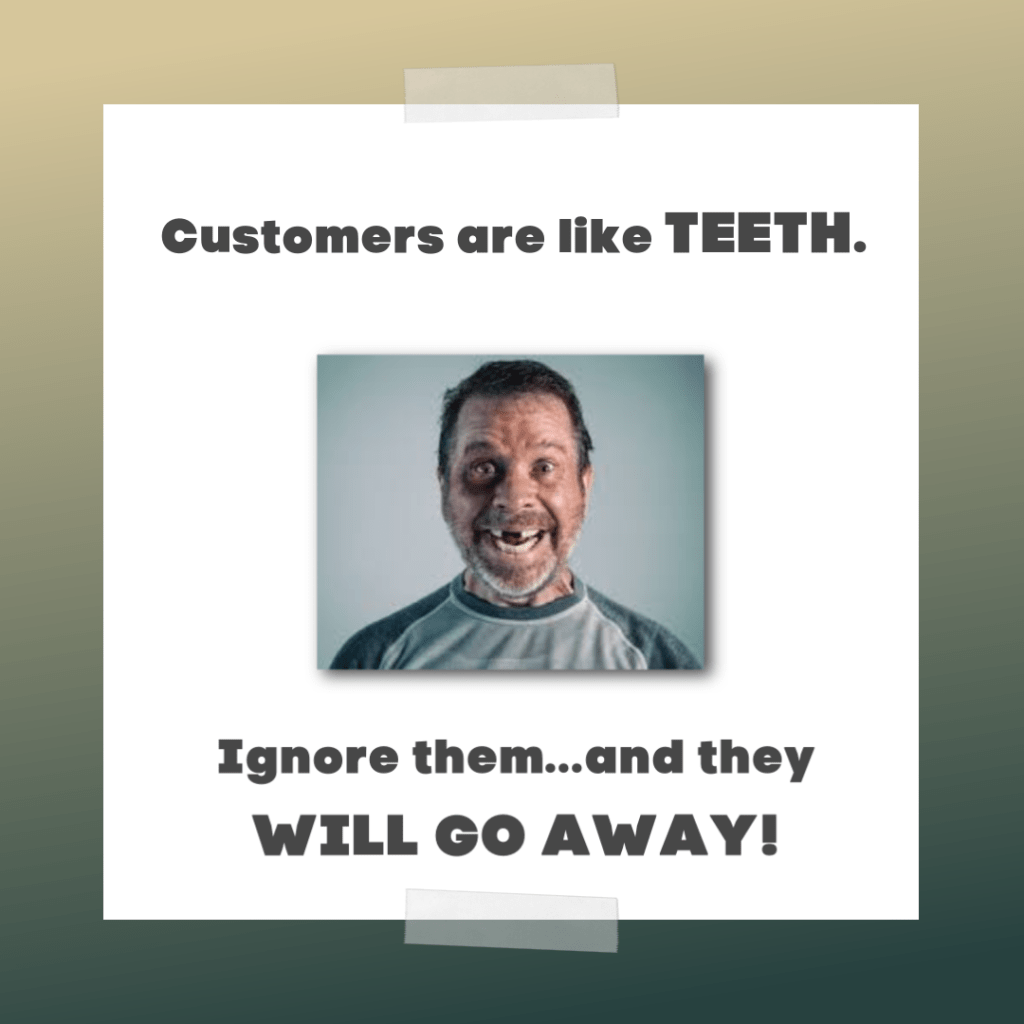
Customers Are Like Teeth—Ignore Them and They Will Go Away

Blog by Tracy Stock, CSP

My monthly cellular phone bill increased $30 this past month with no explanation and I was upset. When I called and made my way through the automated phone tree 20 minutes later, I finally got to talk to a live person. He said, “No worries, I will figure out what’s going on and then help identify additional services that’ll interest you.” First and foremost, is the timing really right to talk about upselling me when I’m clearly the opposite of happy? The answer is not only “no,” but “H E double hockey-sticks NO!”

What has happened to offering genuine customer service? I never used to offer training in this area simply because I thought customer service was such a basic concept; wow, was I wrong! Sadly, many companies must also think as I used to, because high-quality customer service seems to be essentially non-existent these days.

Customer service should be more than the pillar of a business—it should be the overarching philosophy that carries them every step of the way through operations. After all, my customers are the sheer reason I have a business; without them, Achieve Positive Outcomes wouldn’t exist. Not only does it take training, practice, and industry knowledge to fine-tune your approach, but it also requires walking in your customers’ shoes, anticipating their needs, and then delivering on exactly that. Here is how some of the top service organizations view the idea of customer service:

You Get What You Train For:

  • “Lead a conversation as a person, not as a sales­person. They should speak, and you should listen.” Samuel Thimothy, Co-founder of ONEIMS
  • “We train our employees on the customer journey and what expectations we have for each touch point. We listen to the client, talk to the parties involved to get all sides, and then move quickly to come to a resolution.” Elizabeth Johnson, CEO of PATHFORMANCE­TECHNOLOGIES
  • “Train your team to actively listen. Once someone’s complaint has been fully heard, and you’ve offered appropriate empathy, 99 percent of complaints are on their way to de-escalation.” Mackey McNeill, Founder of MACKEY

The Service Mentality:

  • “The customer is my boss. She is the one who signs my paycheck, and every­body else’s paycheck. Our job is to make her unbelievably happy, and surprise and delight her every single day.” Kendra Scott, Founder of KENDRA SCOTT
  • “The connective tissue for everything we do across the company is realizing that we exist to make customers’ lives better and easier every day, and we relentlessly want to do so. Being maniacally focused on the customer experience is always going to be a top priority for us.” Andy Jassy, CEO of AMAZON
  • “The more people you serve, the more lives you change, the happier you are too.” David Neeleman, Founder of JETBLUE

Tricks of the Customer Service Trade:

According to research by McKinsey, 41 percent of business leaders say it takes three to six months to train customer service employees for optimal performance. Leaders from numerous organizations I’ve talked with don’t even come close to providing that level of training for new staff. Happily, though, 80 percent of leaders last year said they plan to increase their customer service budgets for 2023 over last year (Source: Zendesk). If plans are followed with action, we should start to experience improvements soon in the service industry. Wouldn’t that be nice?! Well, I’m quietly cheering on cellular carriers to finish first and come out on top, as we are all affected—positively or negatively—by their ability to serve their customers…namely you and me.

  • “When I first started my business, I used to book a call with every single customer to personally ­onboard them. Keep in mind, all of these customers were on a free trial. What surprised me was that many of these phone calls led not only to paid conversions, but also to referrals, because of the attention we gave them.” Sean Kim, Founder and CEO of JUMPSPEAK
  • “Being quick to hear and act on a complaint is essential. But even when a response is prompt, too often the response focuses on justifying the com­pany’s actions. When we do run into a challenge, we try to see the situation from the customer’s perspective first. From there, we ask questions to understand what their frustration is and generate solutions to address the real issue.” Michael Walters, Founder and President of STUDIO503
  • “We’re incredibly customer-centric. If you visit our site and build a cart but don’t check out, we have somebody who will call you. Not every brand could get away with it, but because we’re so customer-centric, we close about 70 percent of those orders. We push them to the front of the line and ship them day-of. Pretty much everyone who experiences a call like that is so appreciative, and it’s helped us dive deeper into what our customers want.” Charis Jones, Founder and CEO of SASSY JONES

Instead of viewing customers like something we have to tend to…like teeth—“ignore them and they’ll go away”—see customers as invited guests to a party and you are the host! Choose to make it your responsibility every day to make every important aspect of the customer experience a little bit better. Cheers to that!

(Adapted from a recent article in INC. Magazine)

Are You Thriving, Struggling or Suffering?

Blog by Tracy Stock, CSP | Achieve Positive Outcomes, LLC

The idea that “work sucks” is everywhere. In fact, according to the State of the Global Workplace 2022 Report published by Gallup, Inc.—renowned for their public opinion polls conducted worldwide—60% of workers today are emotionally detached at work and 19% are miserable.

So, what makes a job suck? Gallup found the biggest source was “unfair treatment at work.” That was followed by an unmanageable workload, unclear communication from managers, lack of manager support and unreasonable time pressure. Those five causes have one thing in common: your boss. Get a bad one and you are almost guaranteed to hate your job. A bad boss often ignores you, disrespects you and rarely supports you. Environments like that can make anyone miserable.

In fact, someone extremely close to me—who was clearly a rising star and promoted three times in under two years—recently gave notice and said “bye-bye” to his well-paid, degree-aligned leadership position WITHOUT securing another job to replace it. Crazy, you say? Well, I guess when you’ve had enough, you’ve had enough. And he certainly had enough suffering. And the commonality cause cited above mirrored his reasoning, too.

Improving life at work—or having it suck less—may not be easy, but it is rather simple: better leaders in the workplace. Managers need to be better communicators, coaches and collaborators. Awesome managers actually help their teams learn and grow, recognize them for doing quality work, and treat them in a way that makes them truly feel cared about. In environments like this, workers thrive versus struggle.

Following are 10 essential leadership traits or qualities that the best leaders consistently demonstrate and those leaders can focus on to enhance their ability to lead while increasing their chances of success. And guess what…they are not only good for leaders. They are qualities that high performing individual contributors also model:

1. Self-Confidence. Self-confidence is not only one of the essential leadership qualities but possibly the most important professional attribute that you can possess. Leaders who are confident in their abilities are typically more engaged and proactive, leading to better job performance and career advancement.

2. Problem-solving skills. To be successful in any workplace, leaders need to be able to see the situation from all angles and find the best solution for the organization.

3. Integrity. Being honest, adhering to your moral and ethical principles, and doing the right thing (even when it’s not easy or popular) is the foundation of successful leadership. Those with integrity are reliable, trustworthy and dependable.

4. Influence. Influence is the ability to personally affect the actions, decisions, opinions, or thinking of others. Ultimately, influence allows you to get things done and achieve desired outcomes.

5. Communication. The best leaders are skilled communicators who can communicate in a variety of ways, from transmitting information to inspiring others to coaching direct reports. And leaders must also be able to listen to, and communicate with, a wide range of people across roles, geographies, social identities, and more, in an empathetic manner.

6. Visionary. Visionary leadership is characterized by a keen understanding of the future and the ability to see opportunities where others do not. This type of leadership is often required in rapidly changing industries.

7. Accountability. The benefits of accountability are numerous and go beyond simply meeting organizational goals. When individuals are held accountable for their actions, it gives them a sense of responsibility and ownership for their work. Furthermore, it fosters a culture of continuous improvement.

8. Innovativeness. Innovation is a key ingredient in success in the workplace. Innovation ensures new ideas are thought of and put into practice. This leads to better work performance, higher creativity, and a higher level of commitment from employees.

9. Passion. Passion is a powerful leadership quality. Leaders must be passionate about their work to inspire others and drive results.

10. Courage. It can be hard to speak up at work, whether you want to voice a new idea, provide feedback to a direct report, or address a concern for someone above you. Rather than avoiding issues, have the courage to share a tough message in a way that maximizes candor and minimizes defensiveness.

Creating the best leaders—and selecting the right high potentials to fill open leadership roles—definitely isn’t rocket science. After all, every living, breathing adult is already a manager in life; but it does require identifying what leadership traits are critical for your leaders to model and then being very disciplined to ensure you find those individuals who exemplify those qualities. And rather than suffering or struggling, thriving under the right leadership sure sounds like a lot more fun!  

SLEEP is the Magic Pill for Peak Performance!

Blog by Tracy Stock, CSP | Achieve Positive Outcomes, LLC

Everywhere we look there are ads that suggest if we take this or do that, we will have found the secret to more energy, vitality and zest for life. And if there was a magic pill or miracle ointment, would you down it or rub it in? I think it is safe to say, most of us would. Well, no need for special pills nor ointments, and it’s free! What is this magic potion? Sleep. And this one thing has helped me in so many aspects in my life.

Instead of considering how much sleep you can get by with, a much more productive and healthier question to ask is, “How much sleep do I need?”

Interestingly, there are competing beliefs about how much sleep we need. Is it six hours? Seven hours? Eight hours? Is there an optimum amount of sleep necessary for a healthy adult? I don’t think so. In fact, I believe it really depends on the individual and his/her lifestyle and needs.

One thing I know for sure is that sleep offers many benefits for those of us wanting to live healthy lives, such as enhanced memory, helps maintain a healthy weight, lowers blood pressure, decreases stress, stabilizes mood, and strengthens the immune system. But there is one additional benefit that often flies under the radar. Do you want in on the secret?  The huge hush-hush is something that can positively affect any adult, no matter your gender, ethnicity, height, weight, personality style, financial status, etc. Have you figured it out? The clandestine advantage that sleep provides is that it also defies the aging process. Securing “forty winks” is known to be an important time for the body’s repair mechanisms to spring into action, producing growth hormones to help repair tissue damage. Who doesn’t want to capitalize on looking younger and preventing wrinkles?

Now, many people I talk with say, “I realize sleep is important and that there are numerous benefits, but I have a tough time getting a good night’s sleep.” If you happen to have similar struggles getting enough quality shut-eye, you’re not alone. According to the Center for Disease Control and Prevention, more than one-quarter of the U.S. population reports not getting enough sleep, while nearly 10 percent experience chronic insomnia. If you are one of those unfortunate individuals or know someone who struggles with sleep issues, here are ten practical prescriptions to sleep better tonight:

Rx #1: Maintain a consistent sleep schedule. Start by getting to bed and getting up at the same time every day, including weekends. As tempting as it may be, don’t try to make up for a lack of sleep by staying in bed on the weekends. Sleeping in won’t make up for a sleep deficit. In fact, according to a recent Harvard study, when you snooze extra hours to compensate for sleep deprivation, your ability to focus is worse than if you had stayed up all night.

Rx #2: Create a comfy and cozy haven. Make your bedroom environment conducive to how you sleep best in terms of the amount of light, temperature of the room, and appropriate background noise. Plus, if you are able to crawl into a bed that is lined with super soft sheets, it often helps you feel like you are in a positive, comfortable and welcoming space, rather than one you want to jump out of.

Rx #3: If you nap, keep it short. According to the experts, naps can provide significant health benefits, like repairing a body at the cellular level, improving heart function, and providing a more balanced regulation of hormone levels.

Rx #4: Exercise by day to sleep at night. Engaging in regular exercise during the day can help you sleep better at night. However, you should avoid revving yourself up with high-intensity exercise near bedtime. If nighttime is when you are able to exercise, though, and that part of your schedule cannot be altered, choose a more relaxing type of exercise, like yoga versus running. As always, check with your doctor before starting an exercise regimen.

Rx #5: Wind down your brain. Shortly after dinner or at least two hours before heading to bed, take a little time to tie up loose ends from the day and plan out your next one. This way you can have time before bed to let go of anxieties and relax. However, even with your best efforts, clearing your mind before laying your head down for bed can be tough. If this happens, keep a pen and paper handy, within reach of your bed, so you can write down what is on your mind. Even though you are writing in the dark and your penmanship may not be the easiest to read in the morning, you likely will be able to understand the scribbles. More importantly, though, this strategy provides assurance that your concerns or tasks won’t be forgotten and they can be addressed the next day. 

Rx #6: Choose evening snacks wisely. When you want to snack in the evening, choose a healthy one, like a piece of fruit or low-fat crackers. Avoid foods that are spicy and contain a significant amount of oil, as they can trigger heartburn or an upset stomach.

Rx #7: Indulge in a bath.  Before going to bed, try relaxing in a warm bubble bath. It’s also helpful to add a few drops of aromatic lavender oil to the water, which has known calming effects.

Rx #8: Enjoy bedtime reading. Reading is another useful aid to falling asleep gently. Choose short stories or articles that don’t require too much thinking or invoke high emotion.

Rx #9: Treat yourself to a massage. Every time I get a massage, my body feels like a wet noodle and all I want to do is slide into bed and say, “Lights out.” If you have never tried a massage, I highly recommend it. A skilled masseuse will help your body relax and make the tension disappear.

Rx #10: Listen to soft music. For many of us, listening to soft, instrumental music has a relaxing effect, often helping us to fall asleep. Soothing music like this can easily be downloaded to create your own calming collection or you can use a music application to hand-curate a listening experience that is uniquely yours.

Ignore those who say, “If you snooze, you lose,” as that is a very unhealthy view. Realize all the health benefits that sleep provides, and give your body the sleep it needs rather than just the bare minimum. After all, consistently getting the right amount of quality sleep for you is “just what the doctor ordered.”

The Magic Pill to Looking Younger and Preventing Wrinkles REVEALED!

Blog by Tracy Stock, CSP

Everywhere we look there are ads that suggest if we take this or do that, we will have found the secret to more energy, vitality and zest for life. And if there was a magic pill or miracle ointment, would you down it or rub it in? I think it is safe to say, most of us would. Well, no need for special pills nor ointments, and it’s free! What is this magic potion? Sleep. And this one thing has helped me in so many aspects in my life.

Instead of considering how much sleep you can get by with, a much more productive and healthier question to ask is, “How much sleep do I need?”

Interestingly, there are competing beliefs about how much sleep we need. Is it six hours? Seven hours? Eight hours? Is there an optimum amount of sleep necessary for a healthy adult? I don’t think so. In fact, I believe it really depends on the individual and his/her lifestyle and needs.

One thing I know for sure is that sleep offers many benefits for those of us wanting to live healthy lives, such as enhanced memory, helps maintain a healthy weight, lowers blood pressure, decreases stress, stabilizes mood, and strengthens the immune system. But there is one additional benefit that often flies under the radar. Do you want in on the secret?  The huge hush-hush is something that can positively affect any adult, no matter your gender, ethnicity, height, weight, personality style, financial status, etc. Have you figured it out? The clandestine advantage that sleep provides is that it also defies the aging process. Securing “forty winks” is known to be an important time for the body’s repair mechanisms to spring into action, producing growth hormones to help repair tissue damage. Who doesn’t want to capitalize on looking younger and preventing wrinkles?

Now, many people I talk with say, “I realize sleep is important and that there are numerous benefits, but I have a tough time getting a good night’s sleep.” If you happen to have similar struggles getting enough quality shut-eye, you’re not alone. According to the Center for Disease Control and Prevention, more than one-quarter of the U.S. population reports not getting enough sleep, while nearly 10 percent experience chronic insomnia. If you are one of those unfortunate individuals or know someone who struggles with sleep issues, here are ten practical prescriptions to sleep better tonight:

Rx #1: Maintain a consistent sleep schedule. Start by getting to bed and getting up at the same time every day, including weekends. As tempting as it may be, don’t try to make up for a lack of sleep by staying in bed on the weekends. Sleeping in won’t make up for a sleep deficit. In fact, according to a recent Harvard study, when you snooze extra hours to compensate for sleep deprivation, your ability to focus is worse than if you had stayed up all night.

Rx #2: Create a comfy and cozy haven. Make your bedroom environment conducive to how you sleep best in terms of the amount of light, temperature of the room, and appropriate background noise. Plus, if you are able to crawl into a bed that is lined with super soft sheets, it often helps you feel like you are in a positive, comfortable and welcoming space, rather than one you want to jump out of.

Rx #3: If you nap, keep it short. According to the experts, naps can provide significant health benefits, like repairing a body at the cellular level, improving heart function, and providing a more balanced regulation of hormone levels.

Rx #4: Exercise by day to sleep at night. Engaging in regular exercise during the day can help you sleep better at night. However, you should avoid revving yourself up with high-intensity exercise near bedtime. If nighttime is when you are able to exercise, though, and that part of your schedule cannot be altered, choose a more relaxing type of exercise, like yoga versus running. As always, check with your doctor before starting an exercise regimen.

Rx #5: Wind down your brain. Shortly after dinner or at least two hours before heading to bed, take a little time to tie up loose ends from the day and plan out your next one. This way you can have time before bed to let go of anxieties and relax. However, even with your best efforts, clearing your mind before laying your head down for bed can be tough. If this happens, keep a pen and paper handy, within reach of your bed, so you can write down what is on your mind. Even though you are writing in the dark and your penmanship may not be the easiest to read in the morning, you likely will be able to understand the scribbles. More importantly, though, this strategy provides assurance that your concerns or tasks won’t be forgotten and they can be addressed the next day. 

Rx #6: Choose evening snacks wisely. When you want to snack in the evening, choose a healthy one, like a piece of fruit or low-fat crackers. Avoid foods that are spicy and contain a significant amount of oil, as they can trigger heartburn or an upset stomach.

Rx #7: Indulge in a bath.  Before going to bed, try relaxing in a warm bubble bath. It’s also helpful to add a few drops of aromatic lavender oil to the water, which has known calming effects.

Rx #8: Enjoy bedtime reading. Reading is another useful aid to falling asleep gently. Choose short stories or articles that don’t require too much thinking or invoke high emotion.

Rx #9: Treat yourself to a massage. Every time I get a massage, my body feels like a wet noodle and all I want to do is slide into bed and say, “Lights out.” If you have never tried a massage, I highly recommend it. A skilled masseuse will help your body relax and make the tension disappear.

Rx #10: Listen to soft music. For many of us, listening to soft, instrumental music has a relaxing effect, often helping us to fall asleep. Soothing music like this can easily be downloaded to create your own calming collection or you can use a music application to hand-curate a listening experience that is uniquely yours.

Ignore those who say, “If you snooze, you lose,” as that is a very unhealthy view. Realize all the health benefits that sleep provides, and give your body the sleep it needs rather than just the bare minimum. After all, consistently getting the right amount of quality sleep for you is “just what the doctor ordered.”

The Secret to Evicting Toxic Trespassers in Your Head

Blog by Tracy Stock, CSP

No, I don’t own a ton of real estate or have countless tenants, I just have a head occupied with unsafe squatters. I’m not proud of it, but I am human. Some of them make sense and come from significant chapters of my life — an ex’s sister, people who’ve passed away and high-drama friends I’ve lost touch with. Others are more random — the pastor’s Dad who closes every amazing service with an obnoxious commanding rant, a lady in my neighborhood who only reaches out when she needs something from me, or the lawn service worker who likely knowingly blows recently cut grass into my meticulously-maintained flower beds. Combined, they all take up a lot of space in my head that could be admittedly filled with more constructive things, like creating an outline for my next book.

To understand why I — and likely you, too — can’t evict people from our heads, it’s important to look at how they got there in the first place. Whether it’s a breakup, a work conflict or a heated family fight, people make their way in when I focus on those stressful and negative events, replaying them over and over, wondering how the outcome could have been different. This constant replay in my mind causes this event to become an unfortunate trigger for the future. A trigger reactivates a memory about something in the past — especially when high emotions were involved — and just like that, the thought is top of mind. But when I try to fight against that, or try to evict someone from my head, I end up thinking about the past more. If you want to change a bad habit, you have to change the pattern of it.

When wanting to change a pattern to your thinking, you first should label these unwanted thoughts more accurately for what they are — not a threat you have to fight against, but an unwelcome and negative intruder who should be avoided, and if necessary, kicked to the curb. The more you train yourself to stop arguing with them and instead disengage, the less distressing and obtrusive they become. And once you’re able to do that, it’s important then to occupy your mind or headspace with more positive, happy thoughts — such as a recent time you laughed incredibly hard or enjoyed a tender, intimate moment with a loved one. This is what I call the “magic elixir” — viewing life through an optimistic lens by making small adjustments to who and what you allow to occupy your mind. I’d rather let go of those toxic trespassers who enter without permission and instead focus my thoughts on people or things where I feel a sense of happiness, encouragement and inspiration.

Remember, no thought lives in your head rent-free. Each and every one will either be an investment or a cost. Choose to invest in you.