Are You “Driven” to Distraction?

Three evenings ago, my husband and I ordered a pizza to be delivered from a local eatery. We were told the wait time from kitchen-to-door would be about 45 minutes. A little over 75 minutes later, the driver arrives with my husband waiting on the porch. As he approaches the vehicle, the young man steps out of his driver’s-side door and opens the door to the backseat. In a frenzied state, he turns around after looking inside his car, faces my husband and asks, “Where’s the pizza?” My husband replies, “What do you mean?” The driver, incredibly flustered now, says, “Where did the pizza go?” The driver proceeds to look under the seat (really?) and then opens his trunk. He says, “Man, I don’t know where the pizza went. What should I do?” Once again, really? My husband responds, “I guess you may want to head back to the restaurant and see if the pizza is still there.”

I realize mistakes happen. They happen to all of us. Yet, when someone neglects to perform his/her core job responsibility, is that a mistake or an error due to ineffective training? It’s neither. Instead, I believe it’s an example of a huge mental traffic-jam.

So how do you regain mental focus and become productive again? Are there strategies we can apply ourselves and also share with our co-workers to help them? The answer is “yes” and if you want a high-performing workplace culture, it’s important to apply these five practical prescriptions to fine-tune your focus:

Rx #1: Reduce distractions. While it might be as simple as unplugging from your favorite device for a bit, you might find it much more challenging to deal with a colleague who frequently interrupts your train-of-thought. One way to help mitigate this problem is to identify a specific time and place where you can be distraction-free. Be sure to schedule that time in your calendar and find a quiet spot to ensure you can maximize your productivity during that time. Maybe it is only for 30 or 60 minutes per week, but that sure beats never.

Rx #2: Focus on one thing at a time. Juggling multiple tasks at once can dramatically cut down on productivity and it becomes much harder to hone in on the details that are truly important…like remembering to put the pizza in your car. Why? Because our attentional resources are limited so it is important to budget them wisely.

Rx #3: Take a short break. Have you ever tried to focus on the same thing for a long period of time? After a while, your focus starts to break down and it becomes more difficult to devote your mental resources to that specific task. By taking a brief break, you are able to push pause on your level of concentration, helping you to regain mental focus after you have allowed your brain a rest. 

Rx #4: Avoid negative emotions. Negative emotions can represent an “off-switch” for peak performance. If you work in an environment where emotions run high on occasion, you likely wonder when the next outburst will ensue. Do your best to stay clear from unnerving emotional situations and also steer away from letting your unwanted emotions escalate.  If you can’t avoid negative emotions, do your best to control or minimize them as quickly as possible.

Rx #5: Maintain a consistent sleep schedule. Start by getting to bed and getting up at the same time every day, including weekends. As tempting as it may be, don’t try to make up for a lack of sleep by staying in bed on the weekends. Sleeping in won’t make up for a sleep deficit. In fact, according to a recent Harvard study, when you snooze extra hours to compensate for sleep deprivation, your ability to focus is worse than if you had stayed up all night.

Even though we never got to enjoy a delicious piece of pizza pie that night, my husband and I did have a few laughs over the experience and I did get a great story that I couldn’t wait to share with my readers. So the next time you encounter a craving for thick-crust, consider averting a similar outcome by tossing a few ingredients together yourself, staying focused on the oven timer, while saving some dough in the process.

The Discipline to Delay Indulgence

Have you ever wondered why you make some of the decisions that you do? I believe one significant factor that influences one choice over another is a human desire to move toward pleasure and avoid pain. By pleasure I mean things that create feelings of happiness, strength, optimism, energy, or inspiration. With pain, I am referring to feelings of anger, confusion, helplessness, frustration, or even boredom. If you are regularly able to demonstrate self-discipline by delaying pleasure or gratification, your chances for achieving success in life increase substantially. 

According to a landmark Stanford University study, children were provided one marshmallow and given the choice of eating it or waiting fifteen minutes and being rewarded for holding out with a second marshmallow. Some kids ate theirs right away. Others waited. But the study’s real significance came years later, when researchers discovered that the children who held out for the reward had become far more successful adults than the children who ate the first marshmallow immediately. This “marshmallow theory” was found to explain that the key difference between success and failure is not merely hard work or intelligence, but the ability to delay gratification.

If you are looking to delay gratification, like to save money now to be able to purchase a more desirable item in the future, here are five strategies to help you stand strong:

1. Be clear on your values and what matters most. Have a clear understanding of what is important to you and what you want to accomplish. When you realize these aspects, you are more likely to make choices that can help you achieve the goals and success you desire.

2. Break down big projects/goals. Just like running, athletes train very differently for a sprint than a marathon. The long project will help you to learn about the process, setting mini-goals along the way, and ongoing persistence.

3. Offer visual progress. Use a jar of marbles or some sort of visual tool to demonstrate working toward a goal and making progress versus giving yourself a huge reward after accomplishing a task. Once the jar is full, then you get to reward yourself.

4. Get an accountability partner. Just like it is often times easier to workout with a buddy so that you both are less inclined to stop because you know the other person is counting on you, sharing your plan and progress with an accountability partner can help maintain your focus and discipline.  

5. Frequent reflection. When you find yourself struggling with wanting something now and you’re about to cave in, stop to consciously reflect as to why you are feeling more vulnerable than usual. Try to pinpoint the motivation and reasons behind this strong craving. This time spent in reflection just may be enough to break the cycle of “now” and allow you to postpone the pleasure.

Delaying gratification can be hard-work. Depending on what you want to achieve, it may take weeks, months, years, and sometimes even decades. And even if you don’t always make the best choices, hopefully you learn from the poor ones and appreciate the good ones. As I contemplate my life, I know that when I exercise self-discipline to delay an indulgence or an instant pleasure, I reap the sweet rewards. I tend to appreciate it more, feel a greater sense of accomplishment, and achieve a more successful outcome. Hold it, smell it, or even lick it, but don’t gobble the marshmallow yet.

Personal Challenge: What areas in your life do you feel you need instant gratification and find it difficult to delay? What other strategies do you have for delaying gratification?

Keystone Habits: A Non-Negotiable Routine

Habits are powerful forces. They influence what our brain tells us to do, based on decisions that have become part of engrained routine. Everyone has routines, or habits; things you just do—without thinking about them. According to research from Duke University, up to 45 percent of your actions are unconscious habits. This means that a significant part of what you think, say, feel and do are strongly shaped by your habits—whether they are positive or negative.

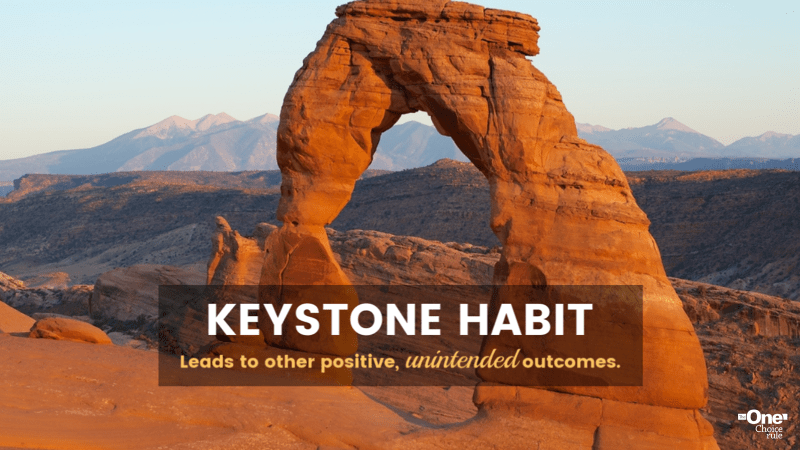
But all habits are not created equal. Some have little impact on your life, and others, referred to as “keystone habits,” can affect your life immensely. Exercising on a regular basis is one example of a keystone habit—which is a habit that creates a domino effect on the rest of your life by naturally influencing you to build more breakthrough routines that produce positive outcomes. Keystone habits are very different from regular habits, like posting a daily message on multiple social media platforms. A regular habit is a positive thing to do, but whether you choose to do it or skip it, it doesn’t have a huge impact on the rest of your life.

By contrast, a keystone habit, like consistently exercising five days per week, is a habit that can also lead to other positive, unintended outcomes like a stronger and more flexible body, enhanced mood, decreased level of stress, reduced risk of heart disease, enhanced productivity, improved quality of sleep and heightened brain function. When you choose to make keystone habits a non-negotiable part of your routine, you change. You take more control of your life and the positive ripple effect naturally occurs. In addition to exercise, three common keystone habits include: active goal-setting, efficiently managing time and saving more money. Three uncommon keynote habits that also create breakthrough routines are:

  • Eat dinner together as a family. Not only does this habit encourage healthier eating patterns—like a greater opportunity for portion control and nutritionally balanced meals—but it also is a perfect setting to expose your family to different foods, save money with less expensive home-cooked entrees, and spend quality time together. Moreover, according to a report by Court Appointed Special Advocates for Children (CASA), when this routine is practiced at least five times per week, a teen’s chance of smoking, drinking, and using drugs is drastically decreased.
  • Make your bed. It may seem irrelevant, but tidying up your bed as part of your morning routine is a small, quick habit that sets a precedent of order and productivity for the day. Creating a neat and organized environment can positively impact your mental state with a small sense of accomplishment—in just 30 seconds, no less.
  • Discard and replace. Choose one day a week, or every other week, or even once a month, where you discard something you don’t love or need. This process helps reduce clutter and gives you the opportunity to replace things that don’t add value with items you enjoy and appreciate.

Rather than going through life without thoughtful intention, make today the day you choose to cultivate one keystone habit. By taking this one small action, you will likely find the momentum to set off a slow avalanche of additional changes, positively transforming your life in amazing ways.

What is Holding You Back?

Success means different things to each of us. Do you consider yourself successful? Are there aspects in your life where you want to be more successful? For many of us, the answer is, “yes.” But one question I often ask my audiences or participants in a workshop is, “Do you know what is holding you back from being more successful?”

I encourage you to think about that question. What’s holding you back from…

  • Taking the next step in your career?
  • Setting the next stretch goal in your personal life?
  • Envisioning a brighter future for yourself? 

Unfortunately, FEAR is a common answer I hear. The truth is…fear kills dreams. Most people don’t live their dreams because of fear. FEAR is described as – False Evidence of Appearing Real – it’s an illusion you create in your mind.  It’s the product of the thoughts you create. On the other hand, danger is very real, but not fear. Perhaps you struggle with the fear of the unknown, fear of failure, fear of rejection, or fear of something else, like not being selected for the promotion you desire, not achieving your wellness goal this year, being unable to fix a relationship issue with a team member, or maybe not being able to learn or do everything you are expected to do in your job.

Courageously facing fears can be daunting. But as I was once reminded, you can have courage or you can have comfort, but you can’t have both. They are mutually exclusive.

Rather than letting your fears hinder your desire to succeed, face your fear. Here are a few ways I have faced my own personal fears:

  • Consider the worst outcome if your fear happens. (Often times, the “worst” isn’t that bad.)
  • Expose yourself to the fear. (Avoiding fear makes it scarier. Face it to help overcome it.)
  • Don’t expect perfection.  (Look at mistakes as an opportunity to do it better next time.)
  • Talk about your fear with someone you trust.
  • Write down your fear on paper; this activity helps to rationalize it.
  • Consider what aspects of your fear you do control. Consider ways to improve those areas.
  • Don’t focus on pain; focus on success. You got this! (explained below).

As noted in the last bullet point above, don’t focus on what’s painful—which is the process of what it takes to make something happen (including potential failure). Because if you focus on the pain, chances of achieving your goal decreases. Pain is temporary—eventually it will subside. But if you quit—it will last forever. Instead, focus on what you want; focus on what success looks like today. For example, if you have a goal to lose 20 pounds, don’t focus on the 10th or 20th pound; instead, focus on today’s plan to eat healthy and incorporate some exercise into your day. Which one seems less daunting to you?

Understanding what is holding you back is the starting point to making your dreams come true and achieving the success you not only desire…but deserve!

Strengthen Your Courage Muscle

Perhaps you are confronted with taking a chance when others will not, or your idea is very unpopular. Maybe you desperately want to follow your vision, no matter where it takes you, but you are meeting intense resistance. Perchance you are simply trying to do the right thing, even though far easier options exist. Most of us are called to be courageous more than we think, and we likely already possess many of the qualities that other remarkably courageous people have demonstrated. But if building definition in your courage muscle is a strength-enhancing exercise you want or need to target, highlighted below are six ways to grow that muscle:

Stop procrastinating and give courage a try. Do your best. Learn from the results of that first attempt and avoid becoming discouraged.

Face what you fear. Look it in the eye and determine exactly what you are afraid of. Rejection? Being laughed at? Not being accepted? Then once you know what you fear, face it and tell yourself, “This fear will pass.” Take one small step, then another. Action builds courage.

Step outside your comfort zone. By being open to meeting new people, visiting a city you have never been to but are curious about, or tasting an appealing entrée, one that you hadn’t considered before, you gradually strengthen your ability to be courageous.

Stand up for others who need it. Find your inner strength to take a stand when necessary. Start by demonstrating courage when someone else is in need, rather than standing up for yourself first, since that is often times less intimidating.

Demonstrate self-discipline. Be very clear about what you want and don’t want, and remain steadfast even when you are enticed to veer off course.

Be willing to fail. True learning happens when things don’t go your way; when you fail or lose. Be willing to fail, but never willing to quit. Failure doesn’t feel good, but the result, if you learn from it, is powerful.

Rather than succumbing to the learned behavior of fearfulness, know your limits, but commit to exercising courage more. If you want to transform your life and not reach the end of your line with regrets, make courage a conscious virtue you need to live with, versus without.

Three Habits to Foster Extraordinary Relationships

Have you ever had time elapse between a relationship with either a friend or a colleague, and then when you re-connect, it’s as if you picked up exactly where you left off? If so, I would say you both had the privilege of sharing an extraordinary relationship.

Extraordinary relationships are built and enhanced through ordinary, yet meaningful, actions. These numerous small acts of kindness, respect and understanding are displayed both consciously and unconsciously. If you want to raise the bar on your relationships, here are three habits to take them to the next level:

Give consistently, receive occasionally. Those who build great relationships don’t think about what they want; instead, they start by thinking about what they can give. They approach building relationships as if it’s all about the other person and not about them—and in the process—they build relationships with others who follow the same approach. In time, they make authentic connections and become genuine friends.

Listen with the intent of understanding, not replying. Research shows that only about 10 percent of us listen effectively—often distracted by technology or our own thoughts. Resist the temptation of considering how to jump in to tell your own story, offer advice, or even make a judgment. Instead, choose to engage in actively listening to the other person’s words and body language—because when you do, relationships prosper and levels of trust grow deeper.

Step in without being asked. It’s both common and easy to help when asked; but very few people offer help before they’ve been asked—even though most of the time that is when a little help will make the greatest impact. Those who build extraordinary relationships pay close attention so they can tell when others are struggling. This demonstration of an empathetic and caring heart enables others to truly appreciate the heartfelt support and assistance, and will also more often times accept the help being offered.

Over the recent Memorial Day weekend, a dear friend whom I’ve known for many years—yet only in the last year have re-connected with—chose to make the trip out to Colorado from Wisconsin. Not only was it an incredible gesture, but we had an amazing time together! We toured the undeniable breathtaking beauty of Red Rock together (home of Red Rocks Amphitheatre), danced and belted out famous tunes sung live in concert by Taylor Swift, and even dined at some of the most exquisite eateries—like downtown Denver’s Ocean Prime. We took in a fun and non-competitive round of Top Golf (as the golfing experts we are…NOT!), squeezed in a little time to indulge in retail therapy at the fabulous FlatIron Crossing shopping center and mall, but most importantly, simply enjoyed each other’s company and meaningful conversation. The relationship I have with my friend, Lisa, is certainly extraordinary and one that I will treasure forever. Make today the day you choose to foster an extraordinary relationship you hold dear. 

Building Unstoppable Self-Confidence

As a professional speaker, I am asked often how I am able to get up on stage, in front of hundreds of people, and speak. One of the greatest pieces of advice I was given early on in my career was that no one in the audience is there for you specifically…they are present to hear your message. And for me, that was enough to help me build my self-confidence and overcome any anxiety of standing up and addressing an audience. By shifting my mental focus away from me and to my message instead, I was able to concentrate more intently on confidently delivering a high-quality, results-focused message in a way that hopefully will resonate strongly and influence behavior change.

I’ve come to realize over the years, that self-confidence is really more of a skill than a trait. And as I age, I seem to acquire more of it, worrying less about what others think of me and focus more on how I can be the best version of “me”. After all, no one is you, but you. So why try to portray someone else? They are already taken, and they certainly aren’t you.

As with any skill, if you don’t exercise that muscle, it will soon become a floppy piece of flesh. So how do I continue to build my self-confidence? Here are 12 simple (not always easy) strategies I use to continuously strive to grow, develop and nurture my self-confidence muscle:

  1. Love who you are. Start each day by looking in the mirror and loving who you see. Self-confidence starts by having a positive perception of yourself.
  2. Insist on positive self-talk. Instead of telling yourself what you did wrong or what needs to change, focus on what you did right. The voices inside your head need to be positive instead.
  3. Forget perfect. Understand that no one is perfect and making mistakes is how you learn.
  4. Start small. Set one or two small goals for yourself every day and every week. As you accomplish them, enjoy that warm, happy feeling that fills your soul.
  5. Journal accomplishments. By making note of positive goals you’ve successfully attained, you have a tool to help enhance your self-confidence if it is ever shaken. Reflect on your achievements often.
  6. Enjoy the feeling of success. Far too often we are more concerned with moving onto the next goal or thing that we don’t celebrate success we just attained. Take a moment and “smell the roses.” It feels amazing!
  7. Give the gift of gratitude. Tell someone how grateful you are to know them. Express how you truly appreciate him/her. Helping others feel special helps us feel good about ourselves.
  8. Dress sharp. You don’t need to spend a lot of money to dress nicely. Wear pressed clothing that fits you well and accessorize your outfit it in a way that emphasizes your assets in a classy manner.
  9. Stand tall. Those who stand with slumped shoulders and walk with lethargic movements display a lack of self-confidence. Make a positive impression by standing up straight, keeping your head up and making natural eye contact.
  10. Be healthy. By eating well, maintaining a regular fitness routine and getting adequate sleep, you are more inclined to feel a strong level of confidence because you know you are taking care of yourself personally.
  11. Compliment someone. When you genuinely offer a compliment to another person, you see him/her light up. That light reflects back to you and feels great.
  12. Prepare. The best strategy I know to demonstrate a high level of self-confidence is to be prepared. Preparation for a task, meeting, conversation, etc. helps you to feel strong and positioned for success.

By demonstrating and continually striving to enhance your level of self-confidence, you can become unstoppable in what you can achieve! There is nothing more attractive than stunning self-confidence. 

Dreams Don’t Work Unless You Do

What is the meaning of the phrase, “Hard work pays off”?

From my perspective, it means that by exerting an intense effort of sweat equity and focused execution, you can achieve the goal you set for yourself. It means rather than relying on luck, set a solid plan and work hard toward it, reaping the fruits of your labor when you accomplish it. After all, you don’t get what you wish for; you get what you work for.

Will there be obstacles? Yes.

Will there be mistakes? Yes.

But with hard work and determination, there are no limits.

As many of my loyal followers know, one of my passions is landscaping—which to me, is the art of beautifying an outdoor space by designing and reshaping visible features of an area of land in an aesthetic, eye-appealing and creative way. And yesterday, I completed a project that I have dreamed about since moving out to Colorado last fall.

See, in Colorado, residential areas often include more rock than grass. And one side of our home landscape was covered 100% in river rock, which lends very little curb appeal, and quite honestly, can be extremely difficult to walk on to get from the back yard to the front. So after our stamped concrete patio was professionally installed, I knew it was time to design a paver walkway that would bring a savvy solution to our issue, offer a creative flair that is unique and beautiful, and achieve an artistic sense of accomplishment that would provide years of enjoyment. Yesterday, my hard work paid off!

Yesterday I finished my dream of designing, planning and executing a 48 foot paver walkway! It started with moving an incredible amount of large river rock with a small hand rake, cutting out the weed barrier, digging through hard clay to form a curvy path, hauling and/or rolling super heavy Goldrush natural patio stones (approx. 16-in x 24-in x 2-in) one at a time, applying polymeric sand under the rocks, laying countless bags of paver sand, spreading even more bags atop the sand with paver base, and lastly placing a layer of decorative pea pebbles to complete the design. Here are several pictures of our natural stepping stone pathway.

Were there obstacles throughout this project? Absolutely! One example was realizing that the natural type of rock I wanted was so heavy that hoisting each of the 26 rocks out of my vehicle and essentially dropping them one at a time into a wagon before hauling them to the side of the house was EXTREMELY labor-intensive…more than I had ever imagined.

Were there mistakes? Yes, again. Because I wanted a varied paver shape and color-scheme, I determined that I had too many of one color and shape, and ended up having to return and replace five of the rocks—which certainly added even more sweat equity to the endurance and pain of the pathway project.

We all have skills and talents unique to us. And utilizing our talents to the best of our ability is essential to helping us make our dreams come true. But remember, dreams don’t work unless you do. Dig deep and put forth a lot of hard work and determination in your next professional or personal project/initiative—and watch your dream become a reality.

When Life Throws You a Curve-ball

Tough stuff happens to all of us. What do you do when life throws you a curve ball? I do my best to dive hard and shout, “Got it!” And when that doesn’t work, I heed my own advice with these five strategies:

  • Accept the new situation or challenge. When a challenging situation is viewed as the possibility to learn something new, you tend to resist it less and embrace it more.
  • Swerve from your routine. Understanding that changes will happen, allows us to establish new ways of doing or looking at something. You may even discover a hidden talent you didn’t know you had.
  • Add some humor in your life. Whether you pay to see a comedian, view some funny videos on You Tube, read a witty book, or talk with an amusing friend. I find a dose of humor helps keep the tears at bay…and potentially, the doctor away.
  • Kill it with kindness. Being kind to others, even when you feel down, helps others to demonstrate kindness to you too. And aren’t more genuine gestures of kindness something we all need?
  • Seek a little adventure. Whether it is choosing to zipline, indoor skydive (like I just did with my boys last week when they visited!), or try something else—stepping out of your comfort zone puts your mind in a challenging and exciting place where you likely aren’t able to focus on the recent twist.

As I frequently remind audiences, every day is a great day when I don’t have daisies growing over my head. So choose to make today the best day ever!

Rethink Inclusion

In the last five years, there has been an estimated 800% increase in virtual/mobile workers. (The Nemertes Research Group). And if you want and need engaged workers from afar, thinking differently about how to help them feel included and part of the team is critical.

One aspect that is rarely exercised for remote workers is building camaraderie and connection through team-building activities. Yes, team-building! Sadly, 65% of remote employees report that they have never participated in a team-building activity. Team-building not only enhances collaboration, but it also decreases isolation. If you want to encourage synergy, promote trust and enhance cooperation with your remote teams—incorporating collaboration activities is essential! Here are eight helpful strategies to consider trying:

1. Social Networking.

You don’t have to invite coworkers to be your friend on Facebook.  But team members can interact through private LinkedIn groups or Yammer pages.  Yammer is like Facebook, but for the corporate setting. According to company statistics, more than 80% of the Fortune 500 is already using Yammer to build employee connections.

2. Get Personal.

Spend a few minutes at the start of each meeting getting those personal updates. Take it one step further and ask team members to send a recent photo to the event organizer. Assemble those into a slide deck to review at the meeting.

3. Virtual Happy Hour or Coffee Break.

Teams all need time to bond with each other outside of their work roles, so top virtual teams take time for a virtual happy hour or coffee break. This is a designated time where team members can connect via chat, conference call, or media to discuss personal and/or professional topics. Some teams have gone so far as to post a “Personal Conversations Only” note on their virtual bar.  It’s a time to connect on a personal level, have a little fun and unwind. This engagement is usually a non-mandatory and bring-your-own-drinks event.

4. Rotational Leadership.

Most members of high-performance teams are fully capable of leading themselves and the group, but unfortunately, they don’t often get a chance. Rotational leadership allows each team member to lead the team—whether it’s simply heading up the weekly phone call, planning a monthly team building activity, or organizing an educational event.

5. Shared Learning.

Think of it as the book group model of team building. Classes, book discussions, and virtual conferences are a way for team members to connect around professional issues, apart from day-to-day work matters. Look for opportunities for virtual team members to attend the same webinar, read a business-related book, or log in to a company conference. Afterwards, connect via phone, Yammer, or instant message to discuss the takeaways.

6. Acknowledgement Round Robin.

More than any other reason, team members leave when they don’t feel a sense of acknowledgment or recognition. Establish a habit of sharing acknowledgements to boost morale. During your text team meeting, ask members to share two specific, timely acknowledgments—one for themselves and one for someone else.

7. Ice Breakers with a Purpose.

We can learn so much about people through powerful questions. Their answers tell a lot about their personality, work style and values. Try asking a question like this to start your next meeting: “What is something you’ve always want to try, but haven’t yet?”

8. Virtual Polling.

Using the polling function in your virtual meeting software, ask a quick round of questions about personal and professional questions to get a read on attitudes and preferences. For example, you could ask, “What is your favorite form of communication—text, phone, email, in-person meetings?” or “What time of day do you feel most energized?” 

These are just a few ways to build virtual teams.  If you have an in-office team in addition to remote team members, look for ways to include the virtual group whenever possible.

For example, it might not make sense to conference someone in to cut a birthday cake, but you can send them a card signed by their office teammates.  They can’t join the office fun run, but they can take part in wellness activities if you provide a way to track activity points online. It’s really just a matter of rethinking inclusion.