When is Enough, Enough?

This morning I heard a radio broadcaster say that she felt sorry for Tom Brady. Even though he won five Super Bowl rings as a Patriot already, she felt bad for him that he and his team didn’t walk away with the Lombardi Trophy yesterday. I found that comment very interesting. I could see if she was a huge Patriots fan, but she wasn’t. That comment got me thinking…when is enough, enough?

When are enough Super Bowl rings enough? When are enough fans or followers enough? When is enough money enough?

I thought back to my 20s and considered the various jobs I had and how I longed for more money. I felt I didn’t have nearly enough. If $12,000 then $18,000 wasn’t enough, what about $30,000? Then came a nice raise, a significant bonus, and then a promotion. But was that enough?

Consider this. If you won or earned one million dollars, would you take risks and work hard to increase that number to five million? Suppose you had five million—would you consider yourself wealthy enough to relax and pursue non-monetary goals, or would you push onward to reach ten million dollars?

When is enough, enough?

This is a question I’ve pondered throughout my life. It’s not a simple question, but one I have found important to allow me to re-focus and bring greater awareness to true meaning in my life. And even though this is a very personal question, it’s true that you pay a price to continue onward and upward, and you pay a price to stop.

As I contemplated “enough”, I thought through several examples.

  • My husband and I own one bed for us and one futon for company. I don’t see a need for another one.
  • My husband and I each own a somewhat modest vehicle. It would be fun to drive around a sports car on date nights, but we certainly don’t need one.
  • A new handbag is something I treat myself to on occasion, but how many handbags does a women really need? The answer is one, maybe two, but certainly not more. Yet, I do own more than two.

So the question I began to ask myself was, “Does having more than two handbags offer me more happiness?” The answer for me is, “No, not really.” And does having more than two take more time out of my day to swap handbags and transfer everything from one to another? Yes, it certainly does. So it is possible to have too much of a good thing? Can less actually be better than more? Once again, the answer for me was, “Yes.”

I then considered, at what point does more money become meaningless in terms of quality of my life?

As a fairly new resident of Colorado, moving to this state from Wisconsin was a huge shock in terms of cost of living. One example is our home, which was about double the price than in WI for similar quality and square footage. I find myself saying, “If we had a little extra money, we could…” But I’m not sure that is true.

My sister recently visited us from out of state. We had a fabulous time hanging out and experiencing new places together, one being Red Rocks Amphitheater & Park. I’ve always wanted to see this geological marvel with a breath-taking panoramic view of Denver and beyond. She recommended eating at the famous restaurant located onsite called Ship Rock Grille. What an amazing experience, which I can describe as incredible awe. 

As I reflect back on the adventure to Red Rocks, it clearly didn’t take a lot of money (gas and lunch) to engage in an incredible experience, but it did take some time and descent health to maneuver around. Likewise, enjoying the company of my sister, niece and nephew-in-law didn’t cost me much money while they were here, but it did require some time to spend with them, cultivating and growing those relationships—which I very much enjoyed doing and personally value tremendously.

So then I got to thinking, “Can more money actually lead to less happiness and perhaps even less freedom?”

Look at famous football players, for instance. They have the ability to buy what they want, but they don’t have the freedom to go where they want without becoming targets of unwanted attention. And when they can’t take their families out to a local venue for some fun because of being bothered for autographs, not only is their freedom limited, but so in the quality of their life experiences.

So the message I share today is that true happiness in life likely doesn’t come from having more; instead, it comes from nurturing what you already have deeper and more meaningfully. And just as those underdog Eagles rose above for the pinnacle football victory yesterday—they surely made a lot of money because of winning—but the experience for each of them as first-time champions will likely be the memory they fondly recall and share heartfelt stories about for many years to come.

March through Milestone Moments

We know that change is all around us. And as we come to the close of another year and prepare for the beginning to a new one, change becomes even more evident. We also likely understand that embedded in every change—or a milestone moment—is challenge, which often times means it is difficult to handle and/or move through. I am a firm believer that if I can understand an issue better, I can deal with it more easily. And because there are predictable dynamics that occur during times of change, I thought mid-December is the perfect time to help you transition into the New Year with increased knowledge and insight, which just may help you handle unexpected changes that lie ahead.

When going through change transitions, most people experience four reactions: denial, resistance, acceptance and commitment. 

  1. Denial. Individuals feel a sense of shock and experience the “why me” victim mentality. The reality of the change hits and most people want and need information. But even though communication is critical, giving small amounts at a time is essential so as to not overwhelm and add unnecessary stress.

One high-profile example of denial was the Libya attack at the US Consulate in 2012. We were again attacked on 9/11 by terrorists. We couldn’t believe it happened again on US soil. A more personal example is of a loved one who was recently terminated from his job. Shortly after he was given the news, he called me completely shaken, crying uncontrollably. He didn’t understand how this could have happened to him; yet, some may say there were warnings, and if they were heeded, perhaps this horrible outcome wouldn’t have ensued.

  • Resistance. When facing this reaction, people need to practice careful planning while also preparing for objections they may receive from others. This reaction to change is very personal and often emotional—with feelings of anger, fear and resentment often be displayed as a result of the change. Employees, colleagues and others are not engaged at work and if the resistance is poorly managed, crisis or chaos may occur.

Hurricane Katrina is a perfect example of resistance. Many people chose not to evacuate before their lives changed forever on August 29, 2006. They resisted leaving everything that was comfortable to them. This devastating hurricane, though, flooded 80 percent of New Orleans, destroyed over 100,000 homes and nearly 2,000 people lost their lives because of it.

A more personal example of resistance at holiday time is over-extending your pocketbook. Instead of realizing that your bank account is almost empty and you’ve begun using credit cards to avoid saying “no” or “I can’t afford that,” some choose to ignore what they know. 

Both reactions drain energy and enthusiasm.

  • Acceptance. This is the turning point for individuals and organizations. As acceptance grows, people explore what the change means to them. It is often viewed as an opportunity to do new things and take some risks. Learning is a key component during this reaction—which takes time and support. Rather than focusing on productivity, garner encouragement and heightened morale by discovering something new and exciting. One example of acceptance is recycling. What once was an idea deemed ridiculous and futile, has now become expected, “the right thing to do,” and frowned-upon when not adhered to.

A more personal example, especially as the New Year turns, is dealing with the battle of the bulge. As pounds tend to stick during the holidays, many head to gyms armed with lofty goals, newfound exercise regimes and healthy eating plans to help whittle the weight off. Those who invest in learning a new way of living—while making significant lifestyle changes—are usually the ones who shrink slowly and successfully.

  • Commitment. The fourth reaction most people experience during times of change is commitment—where they embrace the change and uncover new possibilities that they hadn’t before imagined. Productivity tends to increase and the positive effects of the change are noticed and felt. An important element is to celebrate the achievement and share the success appropriately. One excellent example of commitment is the 9/11 Memorial at Ground Zero in New York. It is a place to honor and remember those who lost their lives and is also a symbol of incredible patriotism and optimism about the future. Here is a three-minute video clip illustrating this powerful feeling.

Both acceptance and commitment are proactive reactions that build energy and enthusiasm.

Most people move through all four reactions; however some get stuck in one of them. Do you know a loved one, a friend or a colleague who is stuck? If so, offer an empathetic ear or extend a helpful hand to lend support and guidance. Sometimes a small act of genuine kindness is all someone needs to march through that infamous steel door. Get unstuck by acknowledging and then working through the undeniable awaited angsts of change. When you do, acceptance will trump denial and commitment will defeat resistance, likely with success following swiftly.

None of Us Are Immune

Blog by Tracy Stock, CSP

We all endure tough stuff. And when life-changing or stressful situations arise, your degree of resilience can dramatically affect how you deal with and move through the hardship.

After all, it’s not the difficult situation that does you in.  It is how you choose to react to it.

Resilience is defined as the process of adapting well in the face of adversity, trauma, tragedy, threats, or even significant sources of stress—such as family and relationship problems, serious health concerns, or workplace and financial stressors. What’s interesting is that research has shown that resilience is quite ordinary, rather than extraordinary. People commonly demonstrate resilience—like how we respond to job loss, personal injuries, illness, relationship issues, death of a loved one, etc. Resilience helps us adapt and recover.

Resilience is not a trait that people either have or do not have. It involves behaviors, thoughts, and actions that can be learned and developed in anyone.

Some additional traits or factors that influence one’s level of resilience are:

  • Make plans and follow through.
  • View of self and confidence in skills.
  • Good at communication and problem solving.
  • Manage strong feelings and/or impulses.

According to research, the most important aspect is “Caring and supportive relationships”—within and the outside family structure. The need for connection with others is primal…as fundamental as the need for air, water and food.

Who signifies resilience to you and why?

There are four types of resilience.

  1. Physical. The body can withstand more stress and heal itself faster.
  2. Mental. You have more mental focus, discipline, determination and willpower.
  3. Emotional. The ability to provoke powerful positive emotions—like curiosity or love—when you need them most.
  4. Social. You get more strength from friends, neighbors, family and the community.

Research has also shown that while some seem to come by resilience naturally, these behaviors can also be learned. Following are 10 strategies to help foster and enhance your own level of resilience:

1.         Nurture a positive view of yourself.

2.         Develop a strong social network.

3.         Be flexible & more accepting of change.

4.         Take steps to solve problems.

5.         Establish reasonable goals & take decisive action.

6.         Take care of yourself.

7.         Keep things in perspective.

8.         Look for opportunities for self-discovery.

9.         Maintain a hopeful outlook.

10.       Ask for help.

We each strive to confront tremendous challenges in life, whether they are poor choices our loved ones make, job stressors that affect our family life in significant ways, or health issues many bravely face, among many others. None of us are immune. My hope is that you realize you can be more resilient—it is more than just a possibility. And as H. Jackson Brown said, “Happiness is not the absence of problems, but the ability to deal with them.” 

Where Has Trust Gone?

Blog by Tracy Stock, CSP

While I was attending the National Speakers Association’s Annual Conference, there was a keynote speaker who asked an interesting question related to trust: Which sector is most trusted for its leadership?

According to his research, here are the results in order of highest level of trust to lowest:

  1. Nonprofit organizations
  2. Business
  3. Education
  4. International organizations
  5. Healthcare
  6. News media
  7. Government
  8. Religious organizations

What’s even more interesting is another statistic that was shared: “Trust in others and confidence in institutions, two key indicators of social capital, reached historic lows among Americans in 2012 in two nationally representative surveys that have been administered since the 1970s.” (Twenge, Campbell and Carter 2014)

Where has trust gone? It appears to be vanishing by the day. High level leaders and powerful influencers are constantly featured in the news today for lying, appearing to have little or even no remorse. From not being able to keep your doctor to patriots losing their lives, it is no wonder why we have a surging dishonestly epidemic. When top leaders demonstrate lying is okay, other leaders often follow suit, and followers are expected to fall in line.

If there is one thing my parents wouldn’t tolerate which I won’t either, is lying. Lying isn’t a mistake or something we accidently do. Lying is the conscious act of intentionally deceiving someone. It hurts countries, organizations and relationships of all kinds.

So why do people lie? According to experts, people lie because they can get away with it, because it works for them. It’s a way to get along with other people. It’s a way to control their world, and it’s a way that they can make other people do what they want them to do.

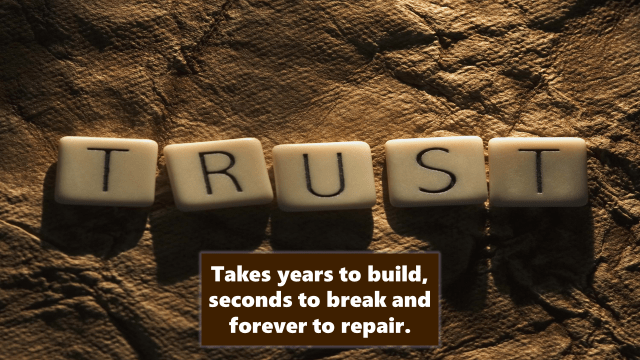
So how do we stop this ever-growing “lack of trust” trend? As there is no quality or characteristic that is more important than trust. It takes years to build, second to break, and forever to repair.

If you want to reverse the negative trust trajectory and instead work toward building it, here are 10 ways to begin making that shift happen:

  1. Tell the truth. Always. Don’t lie. Ever.
  2. Communicate.  Frequent honest and open communication builds trust.
  3. When you falter, admit it. Be willing to share your mistakes and faults.
  4. Demonstrate care and concern toward others. When people realize you care about their interests as much as your own, they will more likely trust you.
  5. Say what you are going to do and then do what you say!
  6. Focus on each interaction—one at a time. Each interaction either adds or subtracts from the current level of trust.
  7. Value long term relationships more than short term success.
  8. Demonstrate vulnerability and transparency. By not hiding your authentic self, you’ll often radiate trust. 
  9. Uphold confidentiality. Don’t break promises by sharing private information with others.
  10. Guide others and look for ways to help people. These actions often lead to earning trust.

As Dr. Brene Brown says, accomplished author and research professor from the University of Houston, “The key ingredient to building trust is courage.” Demonstrate the strength and moral fortitude to align yourself with those you trust, and watch your relationships prosper.

The Yellow-Brick Road to Meaningful Work

Human beings are wired to take the path of least resistance. According to research, our brain tricks us into believing the “low-hanging fruit” is the most appealing and delicious of all. For example, it’s easier to browse the internet aimlessly or be hypnotized in front of one uninspiring TV show after another than it is to spend quality time focused on enhancing our lives with ever-so-high stretch goals which take us out of our comfort zone one lesson at a time and create lasting behavior change with ongoing effort, perseverance and grit. It even sounds exhausting, doesn’t it? 


Rather than pursuing the most comfortable and easiest route, avert the appetizing apple and prevent the provoking pear by taking even the smallest step to catapult you toward meaningful work.

Some organizations excel at creating meaningful workplaces where every employee becomes part of creating success, cohesiveness, and an amazing culture. And some people independently bring a strong sense of meaning and mission with them to work each day. But what if your second home isn’t the envied workplace you desire?

If you want to find more meaning in your work and you’re not ready to take the plunge into the unchartered waters of an ambiguous job search, consider looking for greater meaning using these three strategies:

  • Identify the purpose. Is what you do at work connected to making a positive difference in the lives of others? If it is, realizing this fact will create greater meaning for you.
  • Crave learning. Work offers opportunities to learn, expand your horizon, and enhance self-awareness. This kind of personal growth is meaningful.
  • Seek results. When I accomplish a difficult work task, the results I attain offers me a huge sense of job satisfaction, greater self-confidence and a heightened degree of commitment which can sustain my level of motivation far beyond this one task. I may even be recognized for my achievement, which may offer another unintended reward.

Just like the yellow brick road in the magical Land of Oz led to Emerald City, pave your enchanted path toward greater meaning in your work and you may just discover that “There’s no place like [your second] home.”

One Person’s Value Does Not Equal Another’s

As my closest family and friends know, my husband and I (and our dog, Snickers, too!) are soon relocating to Denver, Colorado. We are super excited about the new adventure, with a lot of nervous feelings surrounding that, of course. This move represents the first time I will be living in another state other than Wisconsin. Cheeseland…is there anything better? I guess I will soon find out. My husband was awarded a fabulous promotion, which he most certainly deserves. His new role will allow him the opportunity to capitalize on his strengths and truly make a difference each and every day…even more than he does today as an EMS helicopter pilot. In his new role, he is responsible for training the pilots and ensuring they are equipped with the tools and knowledge they need to keep them, their crews and patients safe. As for me, I will finally be in a city that has an airport with a major hub. Instead of Delta, United Airlines will now be my go-to choice.

As we are navigating through the daunting process of moving, I have learned that a cross-country relocation is extremely expensive. Wow! And so is the cost of housing in Denver. Yikes! But on the plus side, our new home that is currently being built and will be ready for us in mid-late October, is in a gorgeous suburb of Denver, called Thornton. It is close to everything, but far enough away to be quiet and quaint. Seeing the mountains is breath-taking.

But aside from the mixed feelings of overwhelming and exuberance, I’ve also recently learned that what one person extremely values, another may not.

As you likely realize, we have put our house up for sale and for our first open house we had 10 different families come through. This was an unexpected and outstanding turnout! Yet, still no offers. Our realtor is amazing and sold our last home in less than 24 hours. I can’t say we went into this endeavor with the same expectations, but we are on week three and wondering why there hasn’t been at least one offer so far. Ridiculous…I know.

I keep trying to remind myself that even though we LOVE our current home and think everyone else should too, I realize that it is not the home for everyone…but perhaps most? No. Some. It’s difficult and disheartening to know that those who sauntered through our home didn’t immediately want to buy it like we did, just three years ago. In fact, we purchased it as it was being built and got to watch the process day-by-day of the amazing transformation. I guess my frustration is more about why others wouldn’t see a similar value in our home—to have a similar attraction to buy, protect and care for it in a similar way—but after seeing it, simply dismiss it.

I realized over the course of several days that I needed to not take the selling of our home so personally. Yet, that is easier said than done. I’ve come to the conclusion that even though the eventual buyers of our home may not value it the same as we do, they likely will have a similar affinity for it—which may be less or perhaps, even more.

The unknown in everything we are currently facing is uncomfortable, but exciting. It is a reminder to me to value everyone and everything I have in my life, because gratitude is the best gift of all. Without it, treasured relationships and valued items are just things. And what a shame it would be if that is how we remembered them.

Thanks to all of those special people in our lives. It is because of you that we have the strength to face this new endeavor before us. We will not forget you. In fact, we hope we continue our relationships, wherever they may lead us.

“Bee” Busy Doing the Right Things

I find it interesting that some people can appear super busy, yet don’t necessarily accomplish very much. How is that possible, when others can drive home task after task, project after project.  I believe it is because they spend their time on low-value tasks and procrastinate on the high-value activities that need attention. So they look busy, and truly are, yet they are busy doing the wrong stuff and unfortunately not getting the results they desire.

I recently spoke about this topic at the 2017 National Conference and Exposition for the Society for Human Resource Management (SHRM). I illustrated the point that if we don’t manage our time, other people will, and we will end up stealing it from our spouses, our children and even ourselves. So how we spend our time is an extension of our values. It is important.

When you think of someone who consistently accomplishes a lot, what traits come to mind?

  • Inclusive, collaborative
  • Pleasant, friendly
  • Approachable
  • Delegates well
  • Easy to get along with
  • Positive, laughs, has fun
  • Appreciates & rewards others
  • Accountable
  • Has integrity
  • Does what he/she says they will do
  • Self-disciplined
  • Very organized

None of the traits mentioned include a magic pill; it is simply about clearly knowing what you need to do AND then doing it.

Complete this statement in your head…”I wish I had time to…” For me the answers are, “grab lunch with one of my sons, landscape in our flower garden or enjoy date night with my hubby.”  What are these things worth to me? What is the pay-off? If I stay disciplined, then I’ll get to do these things. If I utilize my time better, this is my reward. 

Don’t let procrastination get in the way of staying disciplined. After all, procrastination is not a character flaw…it’s a bad habit. Instead of giving into excuses, like I used to do much more years ago, consider the metaphor so famously aligned with the insect many of us try hard to evade. Bees don’t know how to procrastinate and likely don’t get side-tracked very often.  They just know how to work hard, and harder, and even harder yet, doing the right things…hence, the phrase, “busy as a bee.”

Let Go and “Kick ‘Em Out of the Nest”

“Holding on” is about bargaining, primarily with yourself. For example, let’s say Ben dislikes his boss; they don’t seem to see eye-to-eye on most things. Ben tells himself that if he can just hang on until the end of the year, he knows he’ll get that promotion and then he won’t have to deal with her anymore. Bargaining, in this context, allows you to wish—but sadly strips you of the ability to make the wish come true.   

In contrast, “letting go” is about facing, and then dealing with, the reality or truth you’re confronted with. It’s about kicking that “if/then” language to the curb, and instead, stepping up to carefully consider your options, making the best decision, and then taking action by following through with that choice.

In addition to our work lives, we face this same dilemma in our personal lives.

Someone very close to me recently started a new job, after the last two were short stints and unfulfilling. I caught myself saying, “If I am able to set him up for success by purchasing these necessary tools for him, then he will be able to perform as expected, he’ll feel confident and happy in his new role, and this opportunity will become the career he has always wanted.” Writing my thoughts down on paper actually made me realize the “if/then” language I had succumb to. You can help set others up for success and that is an admirable gesture. But when you expect others to behave in a certain way because of your actions—similar to my situation—you may be attempting to somewhat control others using an “if/then” mindset.

So in my personal scenario, I decided to not give the new tools to this young tradesman; instead, I offered to purchase and provide the brand new set of tools to him now along with a one-year promissory note, outlining the expectation that the loan will be paid off in one year. Once the note is satisfied, he becomes the official proud owner of the shiny power drills, saws and screwdrivers. He happily signed the note. He was provided with necessary items to begin his new job. He has a responsibility, though, to pay for them. Yet, the tools alone will not determine his fate. It is up to him to choose to arrive at the scheduled start time. It is up to him to pay close attention to the direction provided and learn how things need to be done. It is up to him to utilize his newly-acquired skillset and perform his best.

Letting go is about offering assistance and then knowing when to step aside to allow others to navigate on their own.     

Similar to momma birds caring for their young and then literally choosing to “kick ‘em out of the nest,” letting go is an important part of helping others grow. Whether it’s with a colleague at work or a family member at home, the art of letting go helps prepare others for not only this next step, but the many more that will follow in the future.

Compassion: Are You Born with It?

I have always viewed myself as a rather compassionate person. I try to be kind to others, express empathy, demonstrate genuine concern, and help others in need. In fact, I began my career in speaking to share my message with others in hopes of offering inspiration, support and real connection. However, have you ever paused and reflected on acts that were anything but compassionate? 

As human beings, we each have some standard needs—like food, shelter, and love to survive. We all crave attention, recognition, affection and happiness—to some degree, at least. But what about compassion? Do we need it and are we all equipped to give it?

Recently, I’ve began thinking more about compassion. I wondered if it was a trait that’s innate or one that can be developed. According to research, compassion is something that can be strengthened through targeted exercises and practice, and isn’t something you’re born with. If you’re interested in cultivating compassion, here are a few strategies worth trying:

Encourage cooperation, not competition. Imagine three things you want most in life. Find a partner and get in an arm wrestling position. Every time you are able to successfully pin the other’s arm onto the surface, you win one of those three things you want most. GO! So were you successful? Did you get all three things you want? Most people engage in this exercise and come out with one winner and one loser. But is that necessary? What if you both decided to NOT resist the other, and simply allow your wrist to be pinned, back and forth, back and forth, and back and forth again. After three times, you both will have won your wants. Instead of competing with others and trying to find a way to win and have the other person lose, consider if cooperation might be a better choice. It certainly would have been with this exercise.

Look for commonalities. Seeing yourself as similar to others increases feelings of compassion. Instead of recognizing the differences between yourself and others, try to identify what you have in common—traits, experiences, passions, emotions, etc. Ask yourself, “Is she trying to escape some emotional pain, just like I’ve done before?”

Don’t play the blame game. When we blame others for their misfortune, we feel less empathy and concern toward them. If you don’t know, don’t judge.

Model behaviors you want repeated. Research suggests compassion is contagious, so if you want to help compassion spread in others, lead by example.

Calm your inner worrier. When we let our mind run wild with fear in response to someone else’s pain (e.g., What if that happens to me?), we inhibit the biological systems that enable compassion. The practice of mindfulness can help us feel safer in these situations, facilitating compassion.

Notice and savor how good it feels to be compassionate. Studies have shown that practicing compassion and engaging in compassionate actions bolsters brain activity in areas that signal reward.

Put a human face on suffering. When reading the news, look for profiles of specific individuals and try to imagine what their lives have been like.

Don’t become a victim. When we completely take on other people’s suffering as our own, we risk feeling personally distressed, threatened, and overwhelmed; instead, try to be receptive to other people’s feelings without adopting those feelings as your own.

Know you CAN. When we realize we’re capable of making a difference, we’re less likely to curb our compassion.

When we live our lives with greater compassion, amazing transformations happen. Villains disappear. Perspectives change. Needs are realized. Happiness grows. Kindness multiplies. What will you do today to make a positive difference in another person’s life through expressing compassion?  The beauty is, the more compassion you give, the happier you get. Now that’s one gift worthy of re-gifting.

Handling Tough Feedback with Grace and Tact

So how do you learn to back off the defensive and calmly handle receiving tough feedback? Here are a few ideas that just may help!

1. Stop Your First Reaction. Take one second to process the situation and avoid a dismissive facial expression or negative response. Remind yourself to stay calm.

2. Remember the Benefit of Receiving Feedback. Openly hearing constructive criticism is allows you to consider it and then make the decision on changing a particular behavior—namely, to improve your skills, work product, and relationships—that likely will help you meet the expectations others have of you.

3. Listen for Understanding. Allow the person to share his/her complete thoughts, without interruption, and then repeat back what you heard. For example, “I hear you saying that you want me to…Is that right? Avoid questioning the person’s statement; instead, focus on understanding his/her perspective.

And give the benefit of the doubt here—hey, it’s difficult to give feedback to another person. Recognize that the person giving you feedback may be nervous or may not express his or her ideas perfectly.

4. Say Thank You. Empathetically thank him/her for sharing feedback with you. Say something like, “I really appreciate you taking the time to talk about this with me.” Expressing appreciation doesn’t have to mean you’re agreeing with the comments, but it does show that you’re acknowledging the effort this person took to share his/her thoughts.

5. Ask Questions to Process the Feedback. Ask questions to get to the root of the actual issues being raised and possible solutions for addressing them. For example, if a colleague tells you that you got a little heated in a meeting, here are a few ways to deconstruct the feedback:

  • Seek specific examples to help you understand the issue: “I was a little frustrated, but can you share when in the meeting you thought I got heated?”
  • Acknowledge the feedback that is not in dispute: “You’re right that I did cut him off while he was talking, and I later apologized for that.”
  • Try to understand whether this is an isolated issue (e.g., a mistake you made once): “Have you noticed me getting heated in other meetings?”
  • Seek specific solutions to address the feedback: “I welcome any ideas on how I might handle this differently in the future.”

6. Request Time to Follow Up. If appropriate, articulate what you will do going forward, and thank the person again for the feedback, and then close the conversation. If it’s a larger issue, ask for a follow-up meeting to process the feedback, seek advice from others, and consider solutions.